Medical Cable Compatibility: A Hospital Buyer’s Guide
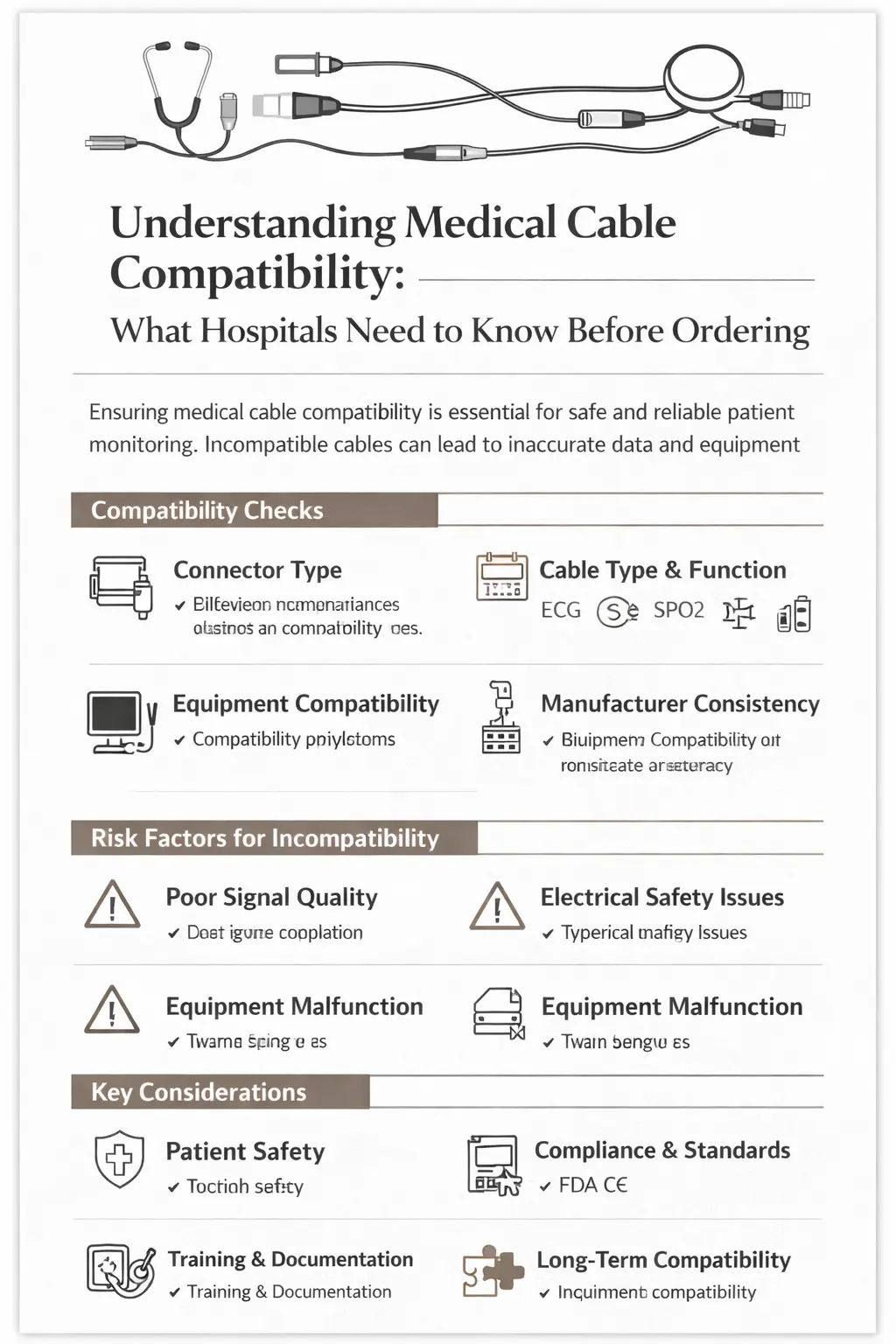
Medical cable compatibility is one of the most common sources of procurement errors in hospital purchasing. Cables that appear similar may have different connector types, lead configurations, or labeling standards that make them incompatible with existing patient monitoring equipment.
Misordering medical cables leads to wasted spend, clinical workflow disruptions, and delays in equipment deployment.
This guide explains what hospitals need to know about medical cable compatibility before placing orders—and how to avoid the most common compatibility mistakes.
Supplier partners that provide medical cable compatibility cross-referencing and connector verification help hospitals reduce misorders and improve purchasing accuracy.
Why Medical Cable Compatibility Matters
Medical cable compatibility affects:
- Patient monitoring accuracy: Incompatible cables may cause signal degradation or intermittent readings
- Equipment warranties: Using non-compatible cables can void manufacturer warranties
- Clinical workflows: Misorders delay equipment deployment and require returns/reorders
- Procurement efficiency: Staff time spent troubleshooting compatibility issues
Hospitals that standardize compatibility verification processes reduce errors and improve purchasing outcomes.
Understanding Connector Types
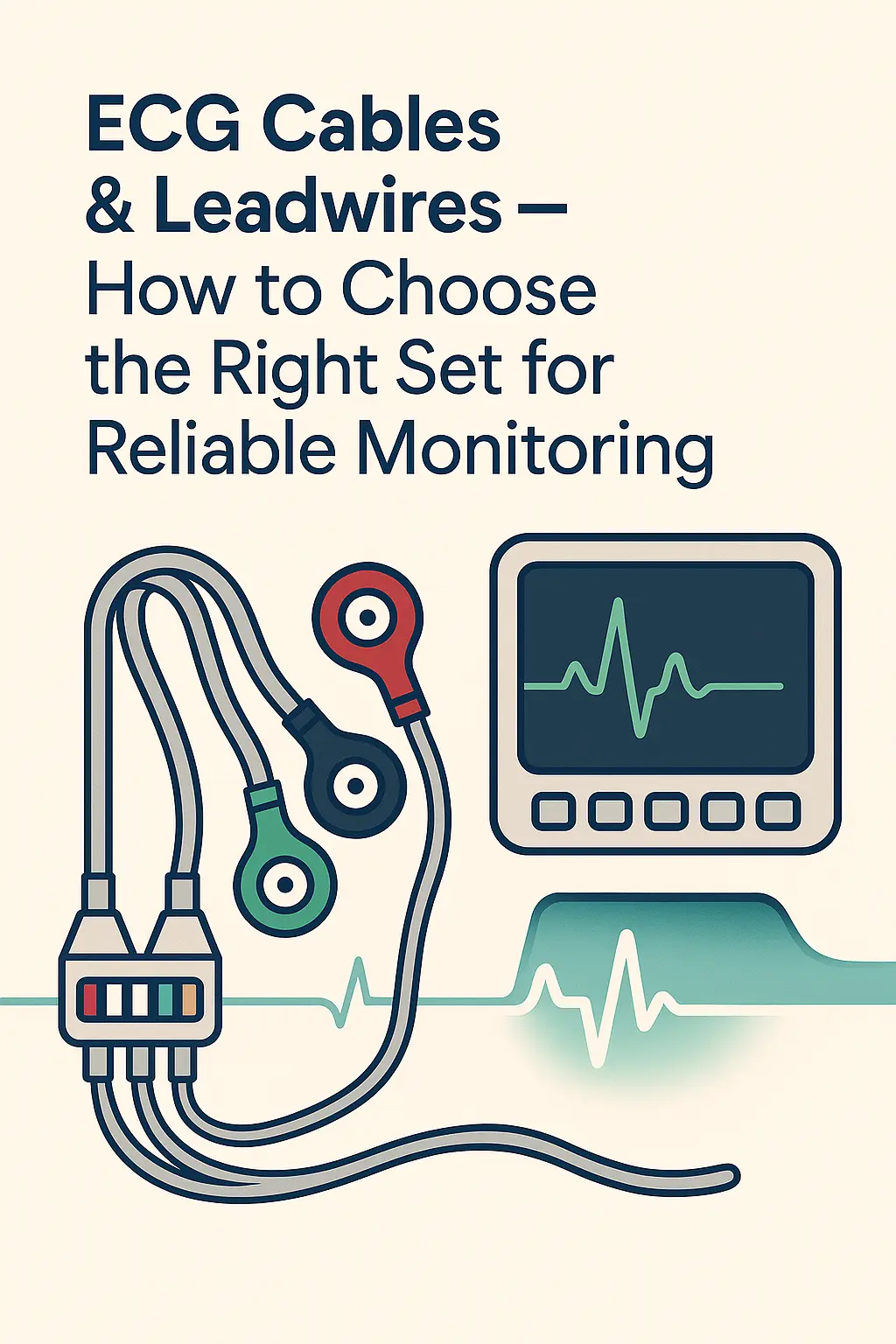
Medical cable connectors are not universal. Even cables designed for the same monitoring parameter (e.g., ECG, SpO₂) may have different connector types depending on the monitor manufacturer.
Common Connector Variations
ECG cables:
- 5-pin DIN connectors
- 6-pin snap connectors
- 12-pin European-style connectors
- Proprietary manufacturer-specific connectors
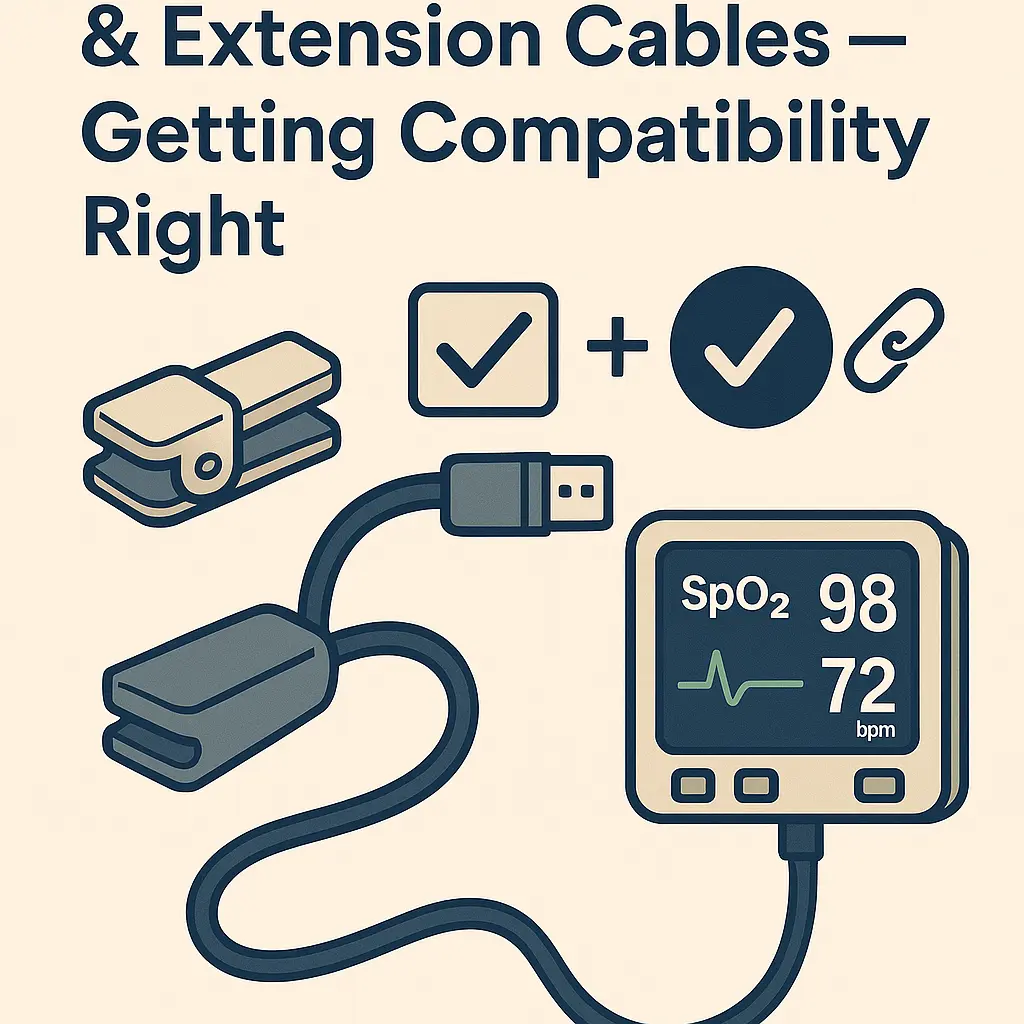
SpO₂ sensors:
- 9-pin D-sub connectors
- 7-pin circular connectors
- Proprietary optical connectors
- Clip-style vs adhesive sensor connectors
NIBP (blood pressure) cuffs:
- Single-tube vs dual-tube configurations
- Luer-lock connectors
- Push-button release connectors
- Bayonet-style connectors
Temperature probes:
- 2-pin connectors
- 400-series YSI connectors
- Disposable vs reusable probe configurations
Without verifying the exact connector type required, hospitals risk ordering incompatible cables.
Suppliers that offer connector identification guides and visual verification tools help procurement teams confirm compatibility before ordering.
Lead Configuration Requirements
Lead configuration refers to the number and arrangement of electrodes or sensors.
ECG Lead Configurations
3-lead ECG: Used for basic rhythm monitoring, typically in telemetry units or transport situations.
5-lead ECG: Standard configuration for most patient monitoring systems, providing 7 views.
12-lead ECG: Used for diagnostic ECG, requires specific lead placement and connector configuration.
Lead Wire Arrangements
- AAMI (American) color coding: White (RA), Black (LA), Red (LL), Green (RL), Brown (V)
- IEC (International) color coding: Red (RA), Yellow (LA), Green (LL), Black (RL), White (V)
Ordering the wrong lead configuration or color-coding standard can result in:
- Incorrect electrode placement
- Confusion during clinical workflows
- Need for staff retraining
- Misinterpretation of monitoring data
Hospitals must document which lead configuration and labeling standard their equipment uses before ordering replacement cables.
AAMI vs IEC Labeling Standards
One of the most common compatibility issues is the difference between AAMI and IEC labeling standards.
AAMI (American Heart Association) Standard
- Used primarily in the United States
- Color coding: White (RA), Black (LA), Red (LL), Green (RL), Brown (V)
- Labeling uses anatomical abbreviations (RA, LA, LL, RL)
IEC (International Electrotechnical Commission) Standard
- Used internationally (Europe, Asia, rest of world)
- Color coding: Red (RA), Yellow (LA), Green (LL), Black (RL), White (V)
- Labeling uses R, L, F, N designations
Key risk: Mixing AAMI and IEC cables can lead to reversed lead placement, incorrect waveform display, and misinterpretation of cardiac rhythms.
Hospitals should:
- Document which standard their equipment uses (AAMI or IEC)
- Clearly specify labeling requirements in purchase orders
- Label inventory to prevent mixing standards
- Train staff on differences between standards
OEM vs Compatible Cable Considerations
Hospitals must decide whether to purchase OEM-grade cables or third-party compatible alternatives.
OEM-Grade Cables
- ✓ Manufactured to original equipment specifications
- ✓ Guaranteed compatibility with branded monitoring systems
- ✓ Typically maintain equipment warranties
- ✓ Consistent quality and performance
- ✗ May have higher unit costs
Compatible Cables
- ✓ Designed to work across multiple monitor brands
- ✓ May reduce upfront procurement costs
- ✓ Can provide acceptable performance if well-manufactured
- ✗ Quality varies significantly by manufacturer
- ✗ May void equipment warranties if not OEM-grade
- ✗ Compatibility claims should be verified
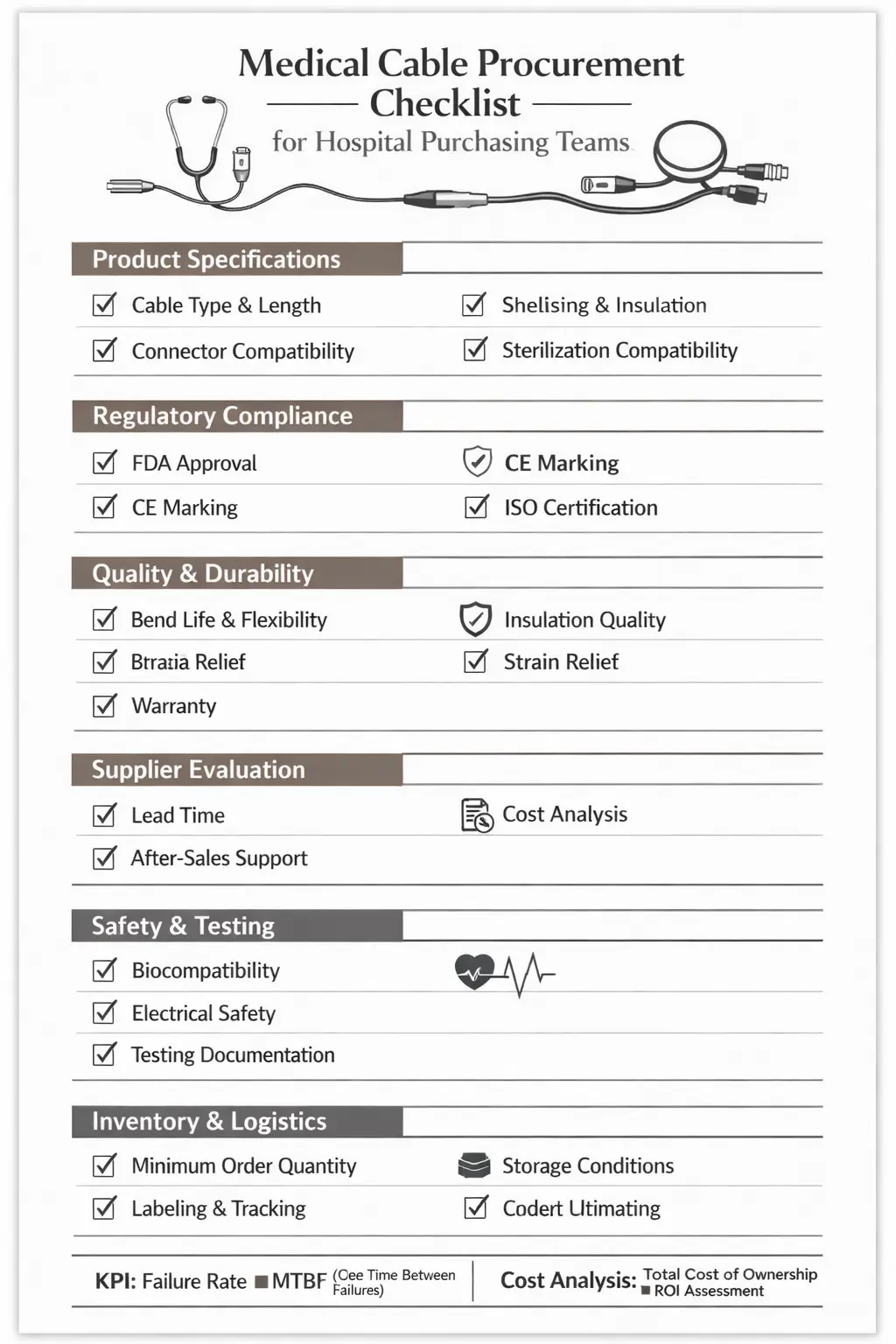
Compatibility Verification Steps
- Confirm connector type matches exactly
- Verify lead configuration and color coding
- Check warranty implications with equipment manufacturer
- Request manufacturer equivalence documentation
- Test cables before bulk ordering
Suppliers that provide OEM-grade compatible cables with documented equivalence help hospitals balance cost and quality without sacrificing compatibility.
Part Number Cross-Referencing
Many hospitals maintain equipment from multiple manufacturers, making part number cross-referencing essential.
Best Practices for Part Number Management
- ✓ Document original part numbers: Record OEM part numbers for all cables in your inventory system.
- ✓ Create cross-reference lists: Maintain internal spreadsheets mapping OEM part numbers to approved compatible alternatives.
- ✓ Verify equivalence claims: Request manufacturer equivalence sheets before purchasing compatible cables.
- ✓ Use visual verification: Compare connectors, lead configurations, and labeling before approving orders.
- ✓ Test before bulk orders: Order sample quantities to verify compatibility before committing to large purchases.
Suppliers that provide part number cross-reference databases and equivalence documentation reduce the administrative burden on hospital procurement teams.
Common Medical Cable Compatibility Mistakes
Mistake #1: Assuming Universal Compatibility
Just because a cable is designed for “ECG monitoring” doesn’t mean it works with all ECG monitors. Connector types, pin configurations, and labeling standards vary.
Mistake #2: Mixing AAMI and IEC Standards
Using AAMI-labeled cables with IEC-configured equipment (or vice versa) can reverse lead placement and create patient safety risks.
Mistake #3: Ignoring Lead Configuration
Ordering 5-lead cables when equipment requires 3-lead (or vice versa) results in incompatible purchases.
Mistake #4: Relying Only on Manufacturer Names
Some manufacturers produce multiple product lines with different connector types. Part numbers are more reliable than brand names alone.
Mistake #5: Not Verifying Warranty Impact
Using non-OEM cables may void equipment warranties or complicate service agreements, even if cables are technically compatible.
Medical Cable Compatibility Verification Checklist
| Compatibility Factor | Verification Step |
|---|---|
| Connector Type | Match exact connector style and pin count |
| Lead Configuration | Confirm 3-lead, 5-lead, or 12-lead requirement |
| Labeling Standard | Verify AAMI (US) or IEC (International) |
| Color Coding | Match color-coding standard to equipment |
| Part Number | Cross-reference OEM part number |
| Cable Length | Confirm required cable length |
| Warranty Impact | Check warranty terms before ordering compatible cables |
| Manufacturer Equivalence | Request equivalence documentation |
Final Thoughts
Medical cable compatibility verification is essential for avoiding costly procurement mistakes. By understanding connector types, lead configurations, labeling standards, and part number cross-referencing, hospitals can improve purchasing accuracy and reduce cable-related workflow disruptions.
Working with suppliers that provide compatibility verification tools, cross-reference databases, and manufacturer equivalence documentation simplifies procurement and reduces risk. If you need help verifying a cable before ordering, contact Medten Support or learn more on Why Medten.
Frequently Asked Questions
Why do medical cable compatibility issues occur?
Compatibility issues occur because connectors, lead configurations, and labeling standards vary across monitor manufacturers. Cables that appear similar may have different connector types or pin arrangements that make them incompatible.
What is the difference between AAMI and IEC labeling?
AAMI (American) labeling uses White (RA), Black (LA), Red (LL), Green (RL), and Brown (V). IEC (International) labeling uses Red (RA), Yellow (LA), Green (LL), Black (RL), and White (V). Mixing standards can reverse lead placement.
How can hospitals verify medical cable compatibility before ordering?
Hospitals should confirm connector types, lead configurations, labeling standards (AAMI or IEC), part numbers, and warranty implications. Working with suppliers that provide cross-reference tools improves accuracy.
Can compatible medical cables be used instead of OEM cables?
Some compatible cables meet high manufacturing standards and work reliably, but quality varies. Hospitals should verify warranty implications, request equivalence documentation, and test samples before bulk ordering.
What happens if hospitals order incompatible medical cables?
Incompatible cables cannot be used with equipment, leading to wasted procurement spend, workflow delays, and the need for returns and reorders. In some cases, forced connections can damage equipment or void warranties.
How should hospitals manage part number cross-referencing?
Hospitals should document OEM part numbers, maintain internal cross-reference lists, verify equivalence claims with manufacturer documentation, and use supplier-provided cross-reference tools to improve accuracy.
Why is lead configuration important for medical cable procurement?
Lead configuration (3-lead, 5-lead, 12-lead) determines the number of electrodes and monitoring views available. Ordering the wrong configuration results in unusable cables and procurement errors.