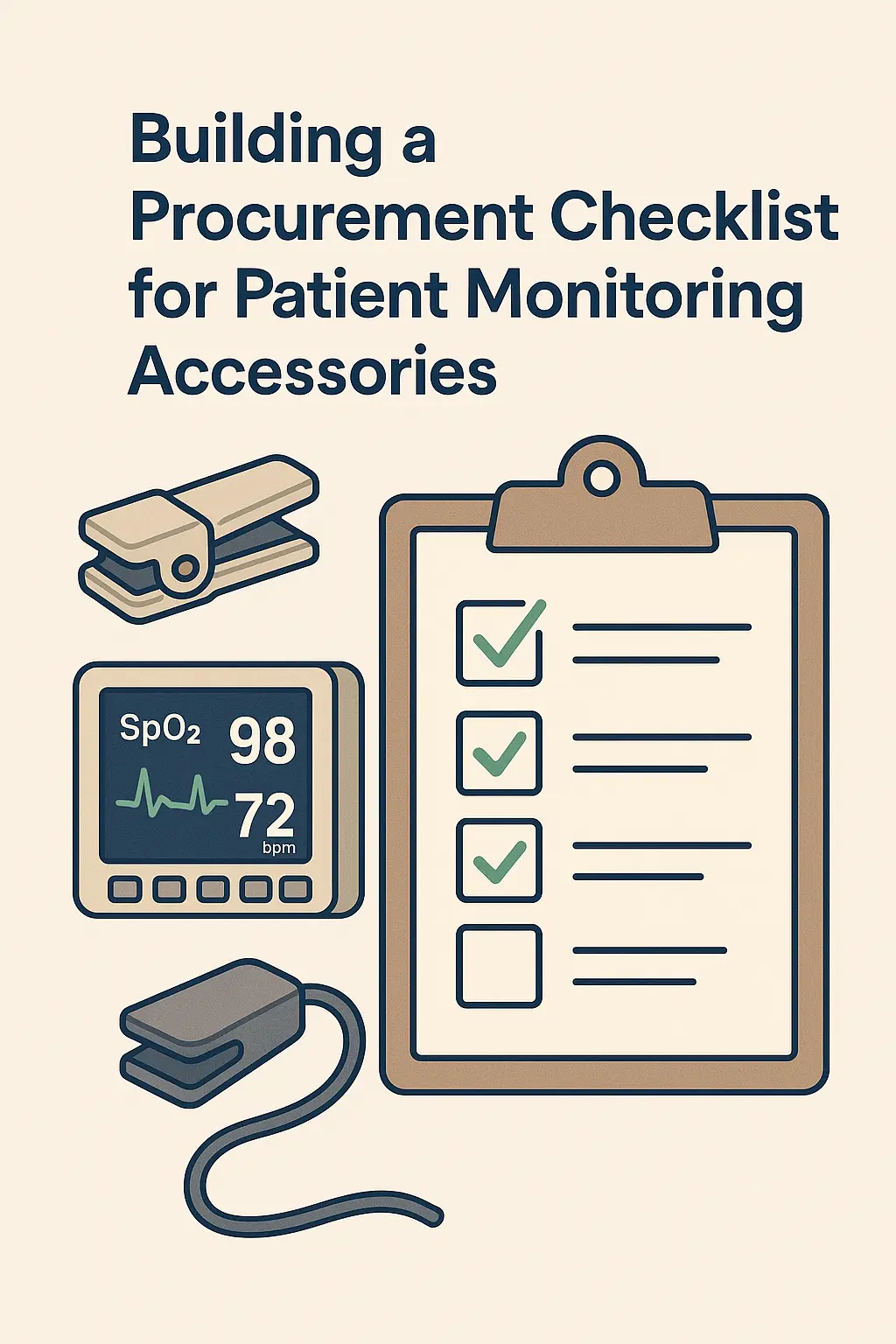
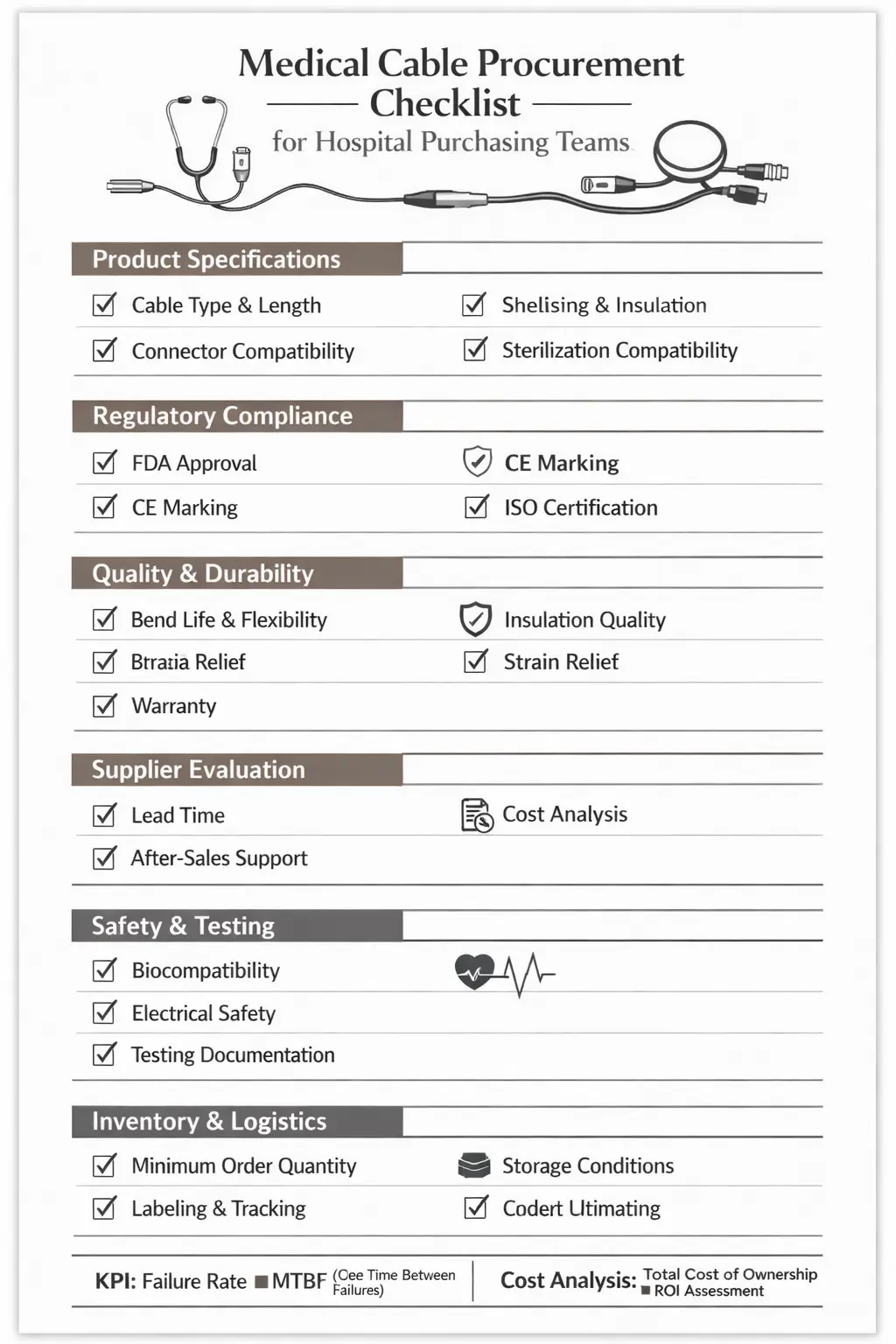
Building a Medical Cable Procurement Checklist: A Framework for Hospital Purchasing
Hospital procurement teams face complex decisions when sourcing medical cables and patient monitoring accessories. Without a structured evaluation framework, purchasing decisions can introduce compliance risk, compatibility issues, or hidden long-term costs.
A well-designed procurement checklist helps hospitals standardize vendor evaluation, reduce ordering errors, and ensure that every medical cable purchase meets clinical, regulatory, and operational requirements.
Supplier partners that support hospitals with medical cable cross-referencing and procurement documentation help streamline purchasing decisions and reduce evaluation time.
This guide outlines the key elements of an effective medical cable procurement checklist for hospital purchasing teams.
Step 1: Define Regulatory and Compliance Requirements
Every medical cable procurement decision starts with regulatory verification.
Key Compliance Checkpoints
- ✓ FDA 510(k) clearance: Verify that cables intended for patient contact or signal transmission have appropriate FDA clearance (where applicable).
- ✓ CE marking: If purchasing for international use or from international manufacturers, confirm CE certification (where applicable).
- ✓ ISO 13485 manufacturing: Suppliers sourcing from ISO 13485–certified manufacturers reduce quality and compliance risk.
- ✓ Traceability documentation: Ensure lot numbers, manufacturing dates, and quality control records are available for audits.
Procurement delays often occur when compliance documentation is incomplete or unclear. Including these requirements in your checklist prevents downstream issues.
Suppliers that provide centralized compliance documentation for medical cables help hospitals streamline internal approval processes and reduce procurement cycle times.
Step 2: Verify Compatibility with Existing Equipment
Medical cable compatibility is not universal. Misordering cables can lead to:
- Wasted procurement spend
- Clinical workflow disruptions
- Equipment damage or warranty voids
Compatibility Verification Checklist
- ✓ Connector type: Confirm exact connector specifications (e.g., 12-pin ECG, clip-style SpO₂, NIBP cuff connectors).
- ✓ Lead configuration: Identify lead count and arrangement (e.g., 3-lead, 5-lead, 12-lead ECG).
- ✓ Labeling standard: Verify whether equipment uses AAMI (American) or IEC (International) color coding.
- ✓ OEM vs compatibility: Determine if OEM-grade cables are required or if high-quality compatible alternatives are acceptable.
- ✓ Part number cross-reference: Document original part numbers and verify compatibility claims with manufacturer equivalence sheets.
Hospitals that work with suppliers offering medical cable compatibility verification services reduce misorders and improve first-time purchase accuracy.
Step 3: Evaluate Supplier Reliability and Performance
Supplier evaluation goes beyond price. Hospitals should assess:
Supplier Evaluation Criteria
- ✓ Supply chain stability: Confirm consistent product availability and realistic lead times.
- ✓ Manufacturing relationships: Understand whether the supplier sources from verified OEM manufacturers or generic suppliers.
- ✓ Quality assurance processes: Ask about incoming inspections, batch testing, and quality control protocols.
- ✓ Return and warranty policies: Clarify warranty terms, return windows, and defect replacement processes.
- ✓ Technical support: Evaluate responsiveness, product knowledge, and troubleshooting assistance.
Including supplier performance metrics in your procurement checklist helps standardize vendor evaluations and reduce subjective decision-making.
Step 4: Calculate Total Cost of Ownership
Unit price is only one component of total cost.
Total Cost of Ownership Factors
- ✓ Replacement frequency: Higher-quality cables last longer, reducing replacement costs.
- ✓ Failure rate: Unreliable cables increase staff time spent troubleshooting and reordering.
- ✓ Warranty impact: Using non-compliant cables may void equipment warranties or complicate service agreements.
- ✓ Downtime costs: Cable failures disrupt patient monitoring and require immediate replacement.
- ✓ Bulk pricing vs quality: Extremely low prices may signal lower manufacturing standards or shorter lifespans.
A procurement checklist that includes total cost of ownership calculations helps hospitals make value-based decisions rather than price-only decisions.
Step 5: Document Internal Approval Workflows
Standardizing internal approvals reduces procurement delays.
Internal Approval Checklist Elements
- ✓ Clinical input: Confirm that biomedical engineering or nursing leadership has reviewed compatibility requirements.
- ✓ Budget approval: Verify that procurement spend aligns with approved budgets and contracts.
- ✓ Compliance review: Ensure regulatory documentation has been reviewed by quality or compliance teams.
- ✓ Contract terms: Clarify whether purchases fall under existing supplier agreements or require new contracts.
Including approval workflows in the procurement checklist improves visibility and accountability across departments.
Step 6: Plan for Emergency Procurement
Unexpected cable failures require fast replacement.
Emergency Procurement Considerations
- ✓ Critical inventory list: Identify high-use cables (e.g., ICU ECG leads, telemetry cables) that should have safety stock.
- ✓ Rush order capabilities: Confirm which suppliers can provide expedited shipping for emergencies.
- ✓ Alternative suppliers: Maintain backup vendor relationships for supply chain redundancy.
- ✓ Pre-approved products: Create a pre-approved list of compatible cables to speed emergency purchasing decisions.
Emergency procurement planning reduces downtime when cable failures occur unexpectedly.
Medical Cable Procurement Checklist Template
Pre-Purchase Evaluation
| Category | Checkpoint | Status |
|---|---|---|
| Regulatory Compliance | FDA 510(k) verified | ☐ |
| Regulatory Compliance | CE marking confirmed | ☐ |
| Regulatory Compliance | ISO 13485 manufacturing | ☐ |
| Regulatory Compliance | Traceability documentation available | ☐ |
| Compatibility | Connector type confirmed | ☐ |
| Compatibility | Lead configuration verified | ☐ |
| Compatibility | Labeling standard identified (AAMI/IEC) | ☐ |
| Compatibility | Part number cross-referenced | ☐ |
| Supplier Evaluation | Supply chain stability assessed | ☐ |
| Supplier Evaluation | Quality assurance confirmed | ☐ |
| Supplier Evaluation | Warranty terms reviewed | ☐ |
| Supplier Evaluation | Technical support evaluated | ☐ |
| Cost Analysis | Unit price documented | ☐ |
| Cost Analysis | Total cost of ownership calculated | ☐ |
| Cost Analysis | Bulk pricing reviewed | ☐ |
| Internal Approvals | Clinical input obtained | ☐ |
| Internal Approvals | Budget approval secured | ☐ |
| Internal Approvals | Compliance review completed | ☐ |
Final Thoughts
A structured medical cable procurement checklist reduces risk, improves purchasing accuracy, and ensures that every cable purchase meets clinical and regulatory requirements. Standardizing procurement processes helps hospitals avoid costly mistakes and build reliable supplier relationships.
Working with suppliers that understand hospital procurement workflows and provide documentation support, compatibility verification, and quality assurance simplifies purchasing decisions and improves long-term outcomes. Learn more on Why Choose Medten.
Frequently Asked Questions
What should be included in a medical cable procurement checklist?
A medical cable procurement checklist should include regulatory compliance verification (FDA/CE), compatibility confirmation (connectors, leads, labeling), supplier evaluation criteria, total cost of ownership calculations, and internal approval workflows.
How do hospitals verify medical cable compatibility?
Hospitals verify compatibility by confirming connector types, lead configurations, labeling standards (AAMI or IEC), and cross-referencing original part numbers with manufacturer equivalence sheets.
Why is total cost of ownership important for medical cable procurement?
Total cost of ownership includes replacement frequency, failure rates, warranty impact, and downtime costs. Low unit prices may increase long-term costs if cables fail frequently or require more replacements.
What compliance documentation should suppliers provide?
Suppliers should provide FDA 510(k) clearance (if applicable), CE certification, ISO 13485 manufacturing verification, traceability records, and quality control documentation.
How can hospitals reduce medical cable misorders?
Hospitals reduce misorders by documenting connector types, lead configurations, labeling standards, and part numbers in a standardized procurement checklist. Working with suppliers that offer cross-referencing services also improves accuracy.
What should hospitals consider when evaluating medical cable suppliers?
Hospitals should evaluate supply chain stability, manufacturing relationships, quality assurance processes, warranty policies, technical support responsiveness, and total cost of ownership—not just unit price.
Why is emergency procurement planning important for medical cables?
Emergency procurement planning ensures hospitals can quickly replace failed cables in critical areas like ICUs and telemetry units. Maintaining safety stock, identifying rush-order suppliers, and pre-approving compatible cables reduces downtime.