Medical Cable Lead Times: Supply Chain Planning for Hospital Biomedical Teams
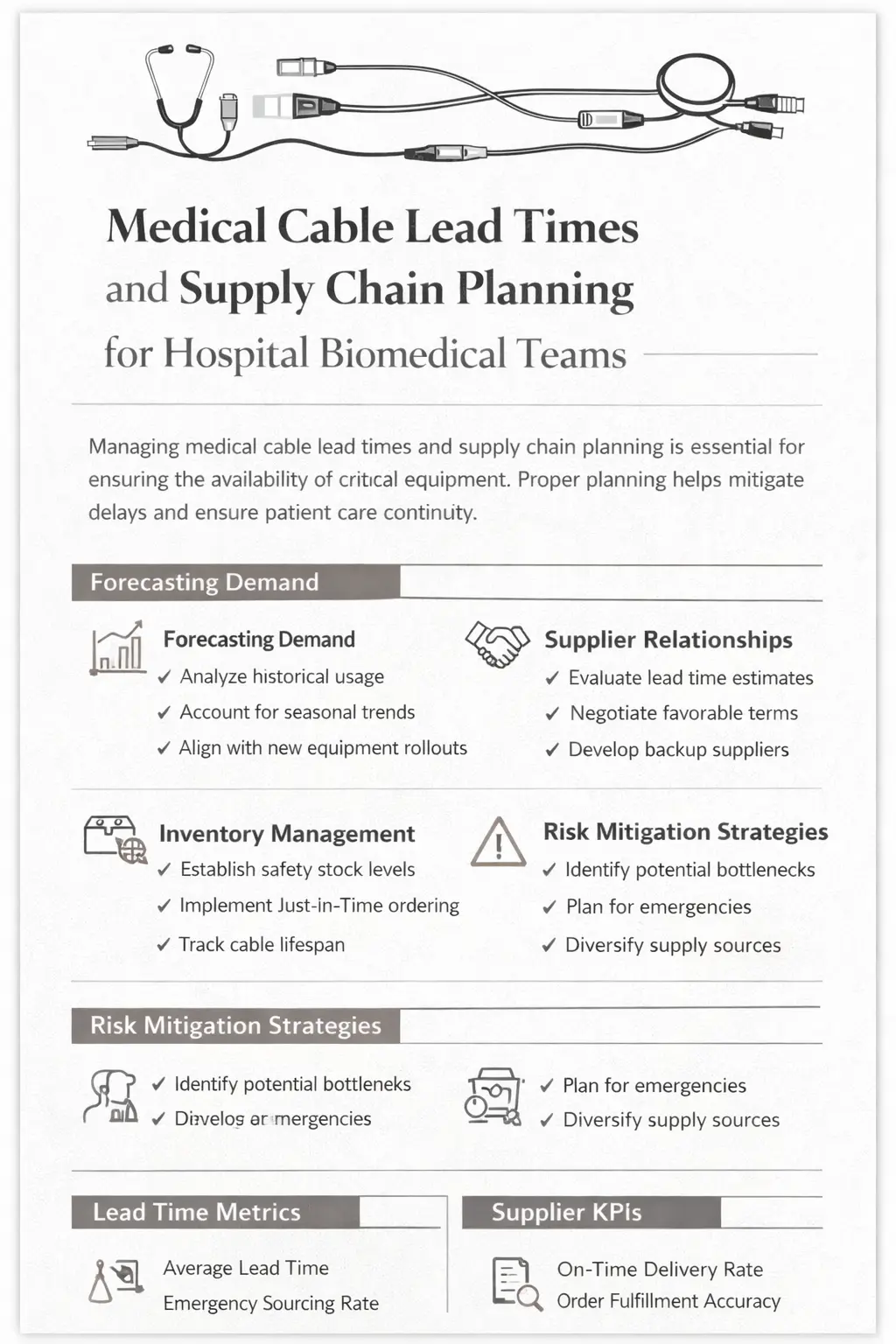
Hospital biomedical teams face a constant challenge: ensuring that medical cables and patient monitoring accessories are available when needed, without overstocking inventory or tying up budget in excess safety stock.
Effective supply chain planning requires understanding lead times, forecasting replacement cycles, and building vendor relationships that support both routine and emergency procurement needs.
This guide explains how hospital biomedical and procurement teams can plan medical cable purchases to minimize downtime, reduce emergency orders, and optimize inventory management.
Supplier partners that provide predictable lead times and emergency order capabilities help hospitals balance inventory efficiency with clinical availability.
Understanding Medical Cable Lead Times
Lead time is the duration between placing an order and receiving usable product. For medical cables, lead times vary based on:
Factors Affecting Lead Times
Product availability:
- In-stock items: 1–3 business days (domestic shipping)
- Low-stock items: 5–10 business days (supplier replenishment)
- Special-order items: 3–6 weeks (manufacturer production)
Supplier type:
- Distributors with inventory: Faster fulfillment
- Direct manufacturer orders: Longer lead times but potentially lower costs
- Drop-ship arrangements: Variable, depends on manufacturer logistics
Order volume:
- Small orders: Faster processing and shipping
- Bulk orders: May require additional production time
- Contract pricing orders: Often prioritized for faster fulfillment
Shipping method:
- Standard ground shipping: 3–7 days (domestic)
- Expedited shipping: 1–3 days (additional cost)
- International shipping: 2–4 weeks (plus customs clearance)
Regulatory factors:
- Routine products: Standard processing
- Special documentation requests: May add 3–5 days for compliance review
Hospitals should work with suppliers to establish realistic lead time expectations for commonly ordered cables.
Forecasting Medical Cable Replacement Cycles
Proactive forecasting reduces emergency orders and supply disruptions.
Steps for Forecasting Cable Needs
- Track historical usage patterns
- Review past 12–24 months of cable purchases
- Identify high-use departments (ICU, telemetry, ED)
- Note seasonal variations (winter flu season, summer trauma cases)
- Calculate average lifespan
- Document typical cable lifespan by type
- Track failure rates by manufacturer or product line
- Identify cables with shorter-than-expected lifespans
- Monitor inventory levels
- Establish minimum stock levels for high-use cables
- Set reorder triggers before inventory reaches critical levels
- Use inventory management software to track usage rates
- Plan for equipment changes
- Anticipate cable needs when purchasing new monitoring equipment
- Order compatibility cables before equipment delivery
- Phase out incompatible cables as equipment is retired
- Build in buffer time
- Add 2–3 weeks to supplier-quoted lead times for safety margin
- Account for potential supply chain disruptions
- Maintain small emergency stock for critical cable types
Biomedical teams that implement forecasting processes reduce reactive purchasing and improve budget predictability.
Emergency Procurement Strategies
Despite careful planning, cable failures and unexpected equipment needs require emergency procurement capabilities.
Building Emergency Procurement Readiness
Identify critical cable types:
- ECG cables (3-lead, 5-lead for ICU/telemetry)
- SpO₂ sensors (adult, pediatric, neonatal)
- NIBP cuffs (multiple sizes)
- Temperature probes (critical care)
Establish expedited ordering protocols:
- Pre-approved supplier relationships for rush orders
- Documented internal approval workflows for expedited purchases
- Company credit accounts to avoid PO delays
- Contact lists for after-hours ordering (if available)
Maintain strategic safety stock:
- 2–3 units of high-failure cables
- Backup cables for equipment with long lead times
- Loaner cables for temporary use during emergencies
Develop supplier relationships:
- Identify suppliers with same-day or next-day shipping capabilities
- Confirm which products are typically in stock
- Negotiate expedited shipping terms in advance
- Establish backup suppliers for redundancy
Hospitals that prepare for emergency procurement reduce equipment downtime and minimize workflow disruptions.
Suppliers that offer same-day order processing and expedited shipping options provide critical support during equipment failures or unexpected equipment deployments.
Vendor Reliability and Supply Chain Stability
Vendor reliability directly impacts hospital supply chain predictability.
Evaluating Supplier Lead Time Reliability
On-time delivery rate:
- Track percentage of orders delivered on or before promised date
- Document delays and reasons (supplier issue vs shipping carrier)
- Set minimum acceptable performance thresholds (e.g., 95% on-time delivery)
Communication quality:
- Responsiveness to order status inquiries
- Proactive notification of delays or stock issues
- Accuracy of lead time estimates
Stock availability:
- Percentage of orders filled completely on first shipment
- Frequency of backorders or partial shipments
- Ability to provide inventory visibility before ordering
Contingency planning:
- Supplier’s backup manufacturing sources
- Geographic distribution of inventory (reduces shipping delays)
- Financial stability (reduces risk of supplier business disruption)
Biomedical teams should periodically review vendor performance metrics and consider diversifying suppliers for critical cable types.
Balancing Cost and Lead Time
Shorter lead times often come with trade-offs:
Cost vs Lead Time Considerations
| Factor | Standard Lead Time | Expedited Lead Time |
|---|---|---|
| Unit Cost | Lower | 10–30% premium |
| Shipping Cost | Standard ground | Expedited surcharge |
| Availability | May require waiting | Typically in-stock items only |
| Order Minimums | May be higher | May be lower |
| Planning Required | 2–4 weeks advance | Reactive ordering |
When to accept longer lead times:
- Routine replacement of non-critical cables
- Bulk orders for cost savings
- Low-urgency equipment upgrades
- Budget-constrained purchasing cycles
When to pay for expedited service:
- Critical equipment failures affecting patient monitoring
- Unexpected equipment deployments
- Emergency department restocking
- Urgent compliance or regulatory deadlines
Hospitals should establish internal policies for when expedited purchasing is justified.
Improving Lead Time Predictability
Hospitals can work with suppliers to improve lead time consistency:
Strategies for Better Lead Time Management
- Establish blanket purchase orders
- Pre-negotiated pricing for commonly ordered cables
- Faster order processing (no quote/approval delays)
- Priority fulfillment from supplier inventory
- Schedule regular deliveries
- Monthly or quarterly standing orders
- Predictable replenishment cycles
- Reduces emergency orders
- Request inventory visibility
- Real-time stock availability before ordering
- Advance notice of potential stock-outs
- Alternative product suggestions when primary products are unavailable
- Consolidate suppliers
- Reduces administrative burden of managing multiple vendors
- Improves supplier relationship and priority service
- Simplifies tracking and performance evaluation
- Communicate equipment changes early
- Notify suppliers of upcoming equipment purchases
- Order compatibility cables before equipment delivery
- Plan transitions to avoid supply gaps
Suppliers that support blanket purchase orders and scheduled deliveries help hospitals improve supply chain predictability and reduce administrative workload. To discuss ordering options, submit a request via Medten Inquiry.
Medical Cable Supply Chain Planning Checklist
| Planning Element | Action Item |
|---|---|
| Usage Forecasting | Review 12-month historical usage data |
| Reorder Triggers | Set minimum stock levels for high-use cables |
| Lead Time Documentation | Document average lead times by supplier and product |
| Emergency Protocols | Establish expedited ordering procedures |
| Safety Stock | Maintain 2–3 units of critical cables |
| Vendor Performance | Track on-time delivery rates quarterly |
| Supplier Relationships | Identify backup suppliers for critical items |
| Budget Planning | Build in 10–15% buffer for emergency orders |
Final Thoughts
Effective medical cable supply chain planning reduces equipment downtime, minimizes emergency orders, and improves budget predictability. By understanding lead times, forecasting usage patterns, and building reliable supplier relationships, hospital biomedical teams can ensure that critical monitoring accessories are available when needed.
Working with suppliers that provide consistent lead times, emergency order capabilities, and supply chain transparency supports hospital operational efficiency and clinical readiness. Learn more on Why Choose Medten.
Frequently Asked Questions
What is a typical lead time for medical cable orders?
Lead times vary by product availability. In-stock cables typically ship within 1–3 business days. Low-stock items may require 5–10 days for supplier replenishment. Special-order or custom cables can take 3–6 weeks from manufacturer production.
How can hospitals reduce emergency medical cable orders?
Hospitals reduce emergency orders by forecasting usage patterns, setting reorder triggers before inventory reaches critical levels, maintaining small safety stock for high-failure cables, and establishing reliable supplier relationships.
What factors affect medical cable lead times?
Lead times are affected by product availability (in-stock vs special order), supplier type (distributor vs manufacturer), order volume, shipping method, and any special documentation requirements.
Should hospitals maintain safety stock for medical cables?
Yes, hospitals should maintain 2–3 units of high-failure or critical cables (such as ICU ECG leads, SpO₂ sensors, NIBP cuffs) to handle unexpected failures without workflow disruptions.
How can biomedical teams forecast medical cable replacement needs?
Biomedical teams should track historical usage patterns, calculate average cable lifespans by type, monitor inventory levels, and plan for equipment changes or seasonal variations in patient volume.
What should hospitals look for in a medical cable supplier for supply chain reliability?
Hospitals should evaluate on-time delivery rates, communication quality, stock availability, contingency planning, and the supplier’s ability to provide inventory visibility and expedited shipping when needed.
When should hospitals pay for expedited shipping on medical cables?
Expedited shipping is justified for critical equipment failures, unexpected equipment deployments, emergency department restocking, or urgent compliance deadlines. Routine replacement orders typically use standard lead times.